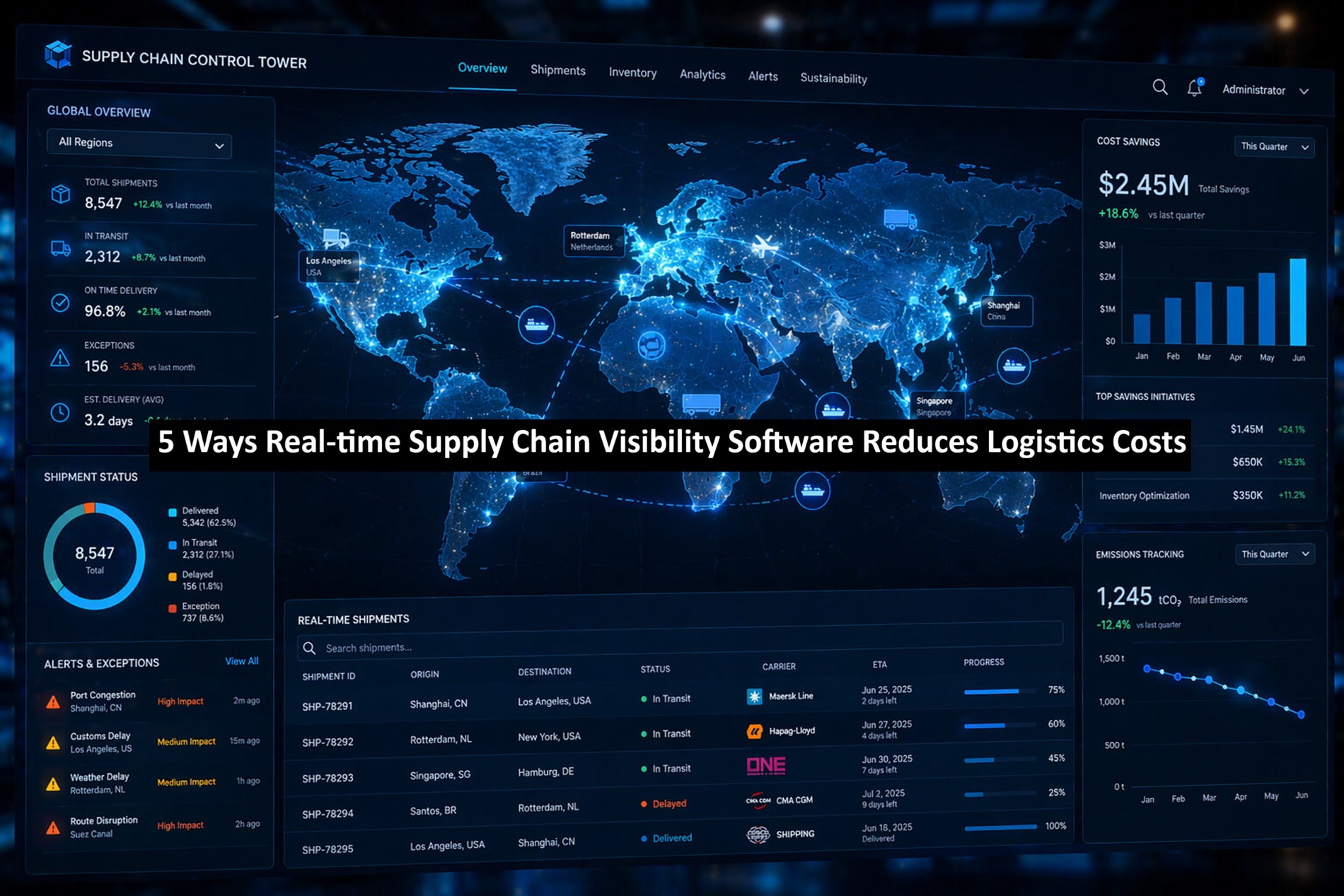
In today’s fast-changing global marketplace “uncertainty” causes financial loss due to lack of visibility into shipping, resulting in “blind spot tax” costing as much as 15 to 20% of total transportation expense.
Software that creates real-time supply chain visibility (SCV) has grown from being an enhancement technology to being essential to helping companies minimize costs. Gartner recently reported there is a rapid increase in the adoption of SCV platforms because companies cannot afford to use guesswork to manage logistics around the world anymore.
Should your aim be to stabilize your profit or increase operational resilience, here are five (5) ways real time visibility software can help reduce logistics costs.
1. Eliminate “Lazy” Costs: Slashing Demurrage and Detention Fees
Poor timing often leads to accessory fees like demurrage and detention charges. A driver arriving at a congested location or waiting longer than the designated “free time” to pick up their container will result in numerous charges, quickly building up to hundreds of dollars each day.
The Visibility Advantage:
Real-time systems with updated GPS-based ETAs along with current traffic patterns can help logistics teams accomplish the following:
- Improve Dock Scheduling – If a shipment is delayed, managers can move available on-site trucks to available dock doors, thereby minimizing employee downtime.
- Prioritize Containers that Might be Late to Ship – Determine the shipment that has the least amount of days left for shipping so that it is delivered first.
- Audit Invoices Automatically – Review the digital timestamps to confirm the carriers’ claims so that only valid wait events are paid for.
Read: Program and its Types
2. Unlock Working Capital by Optimizing Inventory Buffers
Historically, “safety stock” has long been accepted as the way to insure against disruptions in the supply chain. However, maintaining excess inventory is very costly when it comes to insuring against risk. Inventory carrying costs include warehouse rental, insurance and risk of spoilage, and generally amount to about 20% to 30% of a product’s total value each year.
The Visibility Advantage:
Tracking products as they move through their supply chain with at least 99% accuracy presents an opportunity to shift from “just-in-case” inventory to a more efficient and effective “just-in-time” plan or style of inventory management. There will be several advantages of tracking with such a level of accuracy:
- Reduce the variability associated with lead time: With dependable data, you can reduce safety stock levels without increasing your exposure to stockout.
- Improve cash flow: Lowering excessive levels of inventory creates working capital that can be used for other business growth initiatives.
3. Boost Productivity via Automated Exception Management
Old-fashioned “track and trace” is simply a manually performed low-value job, and if your logistic coordinators are doing 50% of their work through phone calls or email with carriers, then you’re not getting all the productivity from your labour in logistics.
The Visibility Advantage:
Management by Exception is achieved using modern visibility software. Instead of tracking and monitoring every shipment, your team will only need to take action if the software raises an alert (e.g. A truck has deviated from its route or a vessel has experienced a weather-related delay).
To attain this level of automation, some enterprise companies are utilizing specialized logistics software development services to link disparate infrastructure systems (legacy ERP) to modern API tracking systems as a unified “source of truth” for everyone involved.
- Operational Scalability: The ability of a business to scale its operations through automated tracking means that a relatively small group of people can manage a much larger volume of freight without adding headcount.
- Faster Problem Resolution: With real-time notifications on delayed shipments, your team can take action and reroute shipments before minor delays become costly operational stoppages.
4. Leverage Data to Negotiate Better Freight Spend
If you don’t measure, you can’t optimize. As a result, many businesses pay a higher freight rate because they do not have the historical data necessary to identify lane inefficiencies or carrier underperformance.
The Visibility Advantage:
Through the analysis of thousands of separate shipments, SCV software provides you with a complete view of how your freight dollars are spent.
- Carrier Scorecarding: Use objective data to negotiate contracts with carriers based on their on-time-performance. Having objective information will give you leverage to negotiate better rates or even to shift some of your business away from unreliable carriers.
- Route Optimization: Identify lanes that have persistent bottlenecks and work with your carriers to develop more efficient alternatives.
- Reducing “Empty Miles”: Planning tools provide visibility to help planners coordinate and optimize their backhaul trips. As a result, you minimize both fuel and labor loss by reducing your “deadhead miles.”
5. Lower the “Cost-to-Serve” by Improving Customer Transparency
The expense associated with a “Where’s My Order?” inquiry is greater than most people know, because these inquiries take away your customer service representative’s time, and not addressing them could lead to the cost of providing service recovery, or the loss of customers as well.
The Visibility Advantage:
Proactive transparency creates a “consumer-grade” experience for both B2B and B2C customers/clients.
- Automated Notifications: Customers will receive automated notifications allowing them to get real-time cargo updates greatly decreasing support volume to your inbound support channels.
- Reduced Churn: By increasing reliability in your organization, diligence becomes a competitive advantage to the transparency of your business. In a very competitive marketplace, typically, the most transparent organization wins customers.
- First-Time Delivery Success: Ensuring that the recipient has the proper personnel and equipment to receive products will help avoid high costs associated with unsuccessful deliveries and re-direction of your products to their final destination.
Final Thought
When implementing a real-time visibility solution within the supply chain, the initial cost should generally be recovered within the first year of operation based on the reduced costs associated with excess fee removal and optimizing safety stock, because that real-time supply chain visibility becomes one of the major cost drivers for your operation.
With what has happened to fuel prices as well as labor availability, having visibility has become more than simply “knowing where my truck is”, but has also become part of the financial physics of how to operate more leanly, more intelligently, and most profitable.
Author’s Bio:
Akshay Tyagi is a content writer at NetClubbed, a premier full-stack development and logistics software development company. He specializes in transforming complex technical insights into clear, actionable strategies that help brands develop their voice and achieve tangible results.